
The Swiss asylum procedure takes place in several stages. Not every person goes through exactly the same process, but generally the procedure follows a similar structure.
Overview of the Asylum Procedure
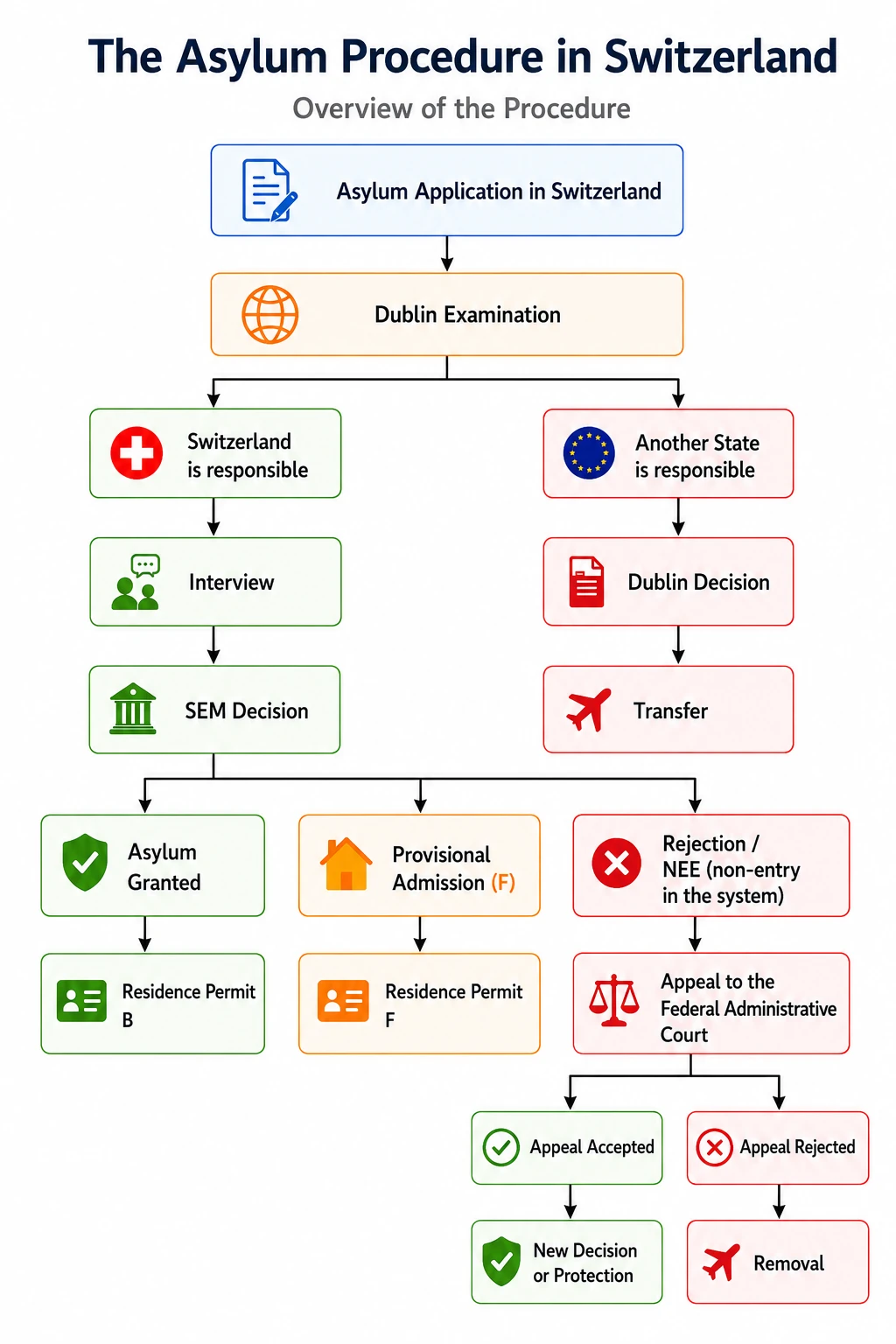
1. Submission of the Asylum Application
A person submits an asylum application in Switzerland – usually at the border, at the airport, or in a federal asylum center.
Afterwards:
- personal data is recorded
- fingerprints are registered
- initial interviews are conducted
- medical and security checks are carried out
The State Secretariat for Migration (SEM) then examines whether Switzerland is actually responsible for the case.
2. Dublin Examination
Switzerland first examines whether another European country is responsible for the asylum procedure.
This takes place within the framework of the so-called Dublin system.
Examples:
- The person has already applied for asylum in Italy or Germany
- The person holds a visa from another Dublin state
- Fingerprints have already been registered in another country
Switzerland not responsible
→ Decision of non-admissibility (NEM)
→ Transfer to the responsible Dublin state
Switzerland responsible
→ The regular asylum procedure is carried out
3. Interview on the Reasons for Asylum
The asylum seeker is questioned about the reasons for fleeing.
This concerns in particular:
- persecution
- war
- political activities
- religion
- ethnic background
- sexual orientation
- personal dangers in the country of origin
The interview is one of the most important parts of the entire procedure.
4. Decision of the SEM
After reviewing the case, the State Secretariat for Migration (SEM) issues its decision.
Granting of Asylum
The person is recognized as a refugee and normally receives asylum as well as a B permit.
Temporary Admission
Removal has been ordered, but cannot be carried out – for example because of war, missing travel documents, or medical reasons.
→ The person usually receives an F permit.
Rejection or Non-Admissibility Decision
The SEM rejects the asylum application or refuses to examine it.
A non-admissibility decision often occurs in Dublin cases or when protection already exists in another country.
5. Appeal to the Federal Administrative Court
A negative decision can be appealed before the Federal Administrative Court (FAC).
Deadlines are often very short:
- sometimes only 5 working days
- usually 7 working days in accelerated procedures
- 30 days in other cases
The court examines:
- whether the procedure was conducted correctly
- whether the facts were assessed properly
- whether the decision is lawful
Appeal Accepted
→ The case is sent back to the SEM
or
→ The court directly grants protection
Appeal Rejected
→ The negative decision remains in force
6. Federal Supreme Court
In asylum law, access to the Federal Supreme Court is very limited.
In many asylum cases, the judgment of the Federal Administrative Court is final.
The Federal Supreme Court may only be appealed to in certain exceptional cases.
7. European Court of Human Rights
In rare cases, an application may still be submitted to the European Court of Human Rights (ECHR).
The ECHR does not re-examine the entire asylum application, but mainly investigates possible human rights violations.
For example:
- risk of torture
- inhuman treatment
- lack of effective legal protection
- violation of family life